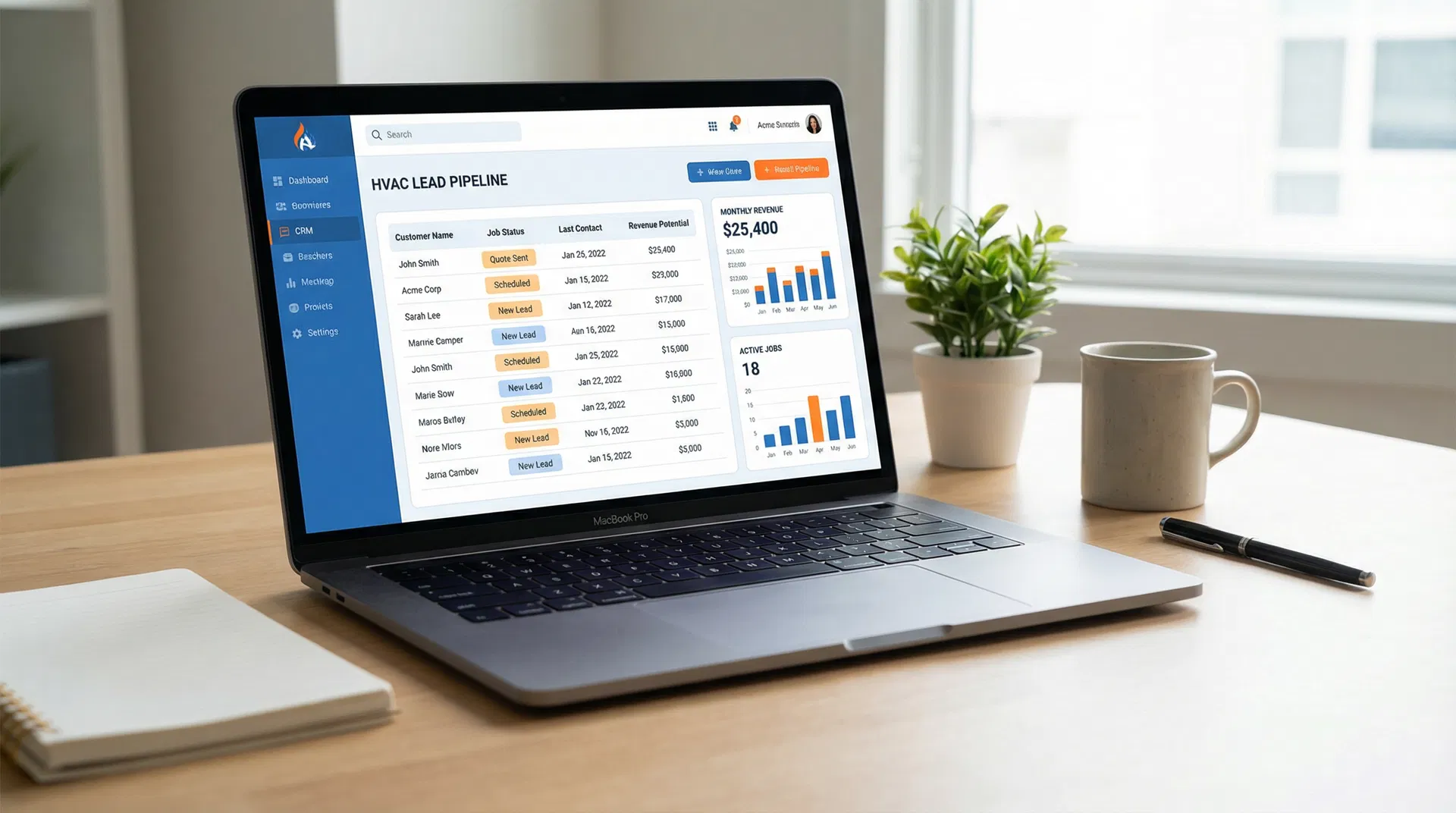
Spreadsheets, sticky notes, and memory are not a CRM. If you're running your HVAC business without a proper customer relationship management system, you're losing leads, missing follow-ups, and leaving serious money on the table every single week.
What a CRM Actually Is — A Plain English Explanation
A CRM, or Customer Relationship Management system, is software that tracks every interaction between your business and your customers and leads. It knows who called you, when they called, what they needed, whether you followed up, what estimate you sent, and whether they booked. It keeps all of this information in one place, accessible to everyone on your team, at any time. For an HVAC company in Phoenix, AZ or Atlanta, GA, a CRM is the difference between running your business reactively — responding to whoever calls loudest — and running it proactively, with full visibility into every lead, every estimate, and every customer relationship in your pipeline.
The Real Cost of Not Having a CRM
- 1Leads fall through the cracks: A lead comes in, gets written on a sticky note, and never gets followed up because the note gets lost.
- 2No follow-up on estimates: Without a system to track which estimates are outstanding, most never get followed up at all.
- 3No customer history: Every time a customer calls, your team has to ask the same questions because there's no record of past service.
- 4No visibility for the owner: You have no idea how many leads you're getting, how many are converting, or where the bottlenecks are.
- 5Inconsistent customer experience: Some customers get great follow-up, others get none — depending entirely on which team member handled them.
- 6No automation: Every follow-up, reminder, and review request has to be done manually — which means it often doesn't get done.
- 7Missed reactivation opportunities: Past customers are never contacted because there's no system to identify who's due for service.
What an HVAC CRM Should Do
A proper HVAC CRM should do five things well: capture every lead from every source (phone, web form, social media, referral) into one place; track every lead through your pipeline from first contact to booked job; automate follow-up sequences for estimates, missed calls, and review requests; store complete customer history including past jobs, equipment details, and communication history; and provide reporting that shows you exactly how your business is performing at every stage of the customer journey. In Dallas, TX and Denver, CO, the HVAC companies growing fastest are almost universally the ones that have invested in a proper CRM and automation stack. The visibility and consistency a CRM provides compounds over time — every lead handled well becomes a customer, every customer becomes a source of reviews and referrals.
GoHighLevel as the Recommended HVAC CRM Platform
GoHighLevel (GHL) has emerged as the platform of choice for HVAC companies that want a comprehensive CRM with built-in automation. Unlike generic CRMs like Salesforce or HubSpot that require extensive customisation, GHL comes with HVAC-specific workflows, SMS and email automation, a built-in phone system, review management, and a booking calendar — all in one platform. The pricing is also dramatically more accessible than enterprise CRM alternatives. For a growing HVAC company in Toronto, ON or Houston, TX, GHL provides capabilities that would cost $2,000 to $5,000 per month on other platforms for a fraction of that cost. This is why it's the platform we build all of our client systems on at The HVAC Lead Co.
How to Migrate From Spreadsheets to a CRM
The migration process is simpler than most HVAC owners expect. Start by exporting your existing customer data — from QuickBooks, ServiceTitan, a spreadsheet, or wherever it currently lives — into a CSV file. Most CRMs can import this directly. You don't need perfect data to start; you need good enough data to begin. Next, set up your lead capture integrations: connect your website contact form, your Google Business Profile, and your phone system to your CRM so new leads flow in automatically. Then build your first automation — start with a missed call text-back, which takes less than an hour to set up and starts recovering revenue immediately. Add complexity gradually over the first 90 days as your team gets comfortable with the platform.
CRM Features That Directly Increase HVAC Revenue
The features that generate the most direct revenue impact for HVAC companies are: automated estimate follow-up sequences (typically increases conversion rate by 15 to 25 points), missed call text-back (recovers 50 to 60 percent of missed calls), post-job review request automation (generates 4 to 8 new reviews per month), and seasonal reactivation campaigns (generates $20,000 to $50,000 per campaign from past customers). Each of these features requires a CRM to run consistently and at scale. Without a CRM, they either don't happen or happen inconsistently — which means the revenue they would generate simply doesn't materialise. In Seattle, WA and Denver, CO, the HVAC companies running these automations through a CRM are growing 2 to 3 times faster than those that aren't.
Common CRM Mistakes HVAC Companies Make in the First 90 Days
The most common mistake is trying to implement everything at once. HVAC owners get excited about all the possibilities, set up 20 automations simultaneously, and then get overwhelmed when things don't work perfectly. The better approach is to implement one automation at a time, measure the results, and add the next one only when the first is running smoothly. The second most common mistake is not training the team. A CRM is only as good as the data going into it. If technicians aren't marking jobs as complete, if dispatchers aren't logging calls, if estimates aren't being entered — the automation can't fire and the reporting is meaningless. Invest in proper onboarding and make CRM usage a non-negotiable part of your team's workflow from day one.
Want This System Built for Your Business?
We install done-for-you revenue systems for HVAC companies. Book a free 30-minute Revenue Audit and we'll show you exactly what's leaking and how to fix it.
Book My Free Revenue AuditFrequently Asked Questions
What is the best CRM for HVAC companies?
GoHighLevel is widely considered the best CRM for HVAC companies because it combines lead management, SMS and email automation, a built-in phone system, review management, and booking calendars in one platform at an accessible price point. It's purpose-built for service businesses and doesn't require the extensive customisation that enterprise CRMs like Salesforce demand.
How much does an HVAC CRM cost per month?
GoHighLevel costs between $97 and $297 per month depending on the plan, making it one of the most cost-effective CRM options for HVAC companies. When you factor in the revenue generated by the automations it enables — missed call recovery, estimate follow-up, review collection — the ROI is typically 10:1 or better within the first 90 days.
Can I use GoHighLevel for my HVAC business?
Yes — GoHighLevel is an excellent fit for HVAC companies of all sizes. It handles lead capture from all sources, automates follow-up sequences, manages customer history, runs review collection campaigns, and provides detailed reporting on your lead pipeline. It's the platform The HVAC Lead Co. uses to build revenue systems for HVAC clients.
How does a CRM help HVAC companies get more booked jobs?
A CRM helps HVAC companies book more jobs by ensuring no lead is ever forgotten, every estimate gets followed up, every missed call gets an instant response, and every past customer gets contacted at the right time. These automations collectively recover revenue that would otherwise be lost to inertia, slow response, and inconsistent follow-up.
What should I look for when choosing an HVAC CRM?
Look for: built-in SMS and email automation, a mobile app for technicians, integration with your phone system, a visual lead pipeline, customer history and job tracking, review request automation, and reporting dashboards. Avoid CRMs that require extensive technical setup or that charge per-user fees that make scaling expensive.