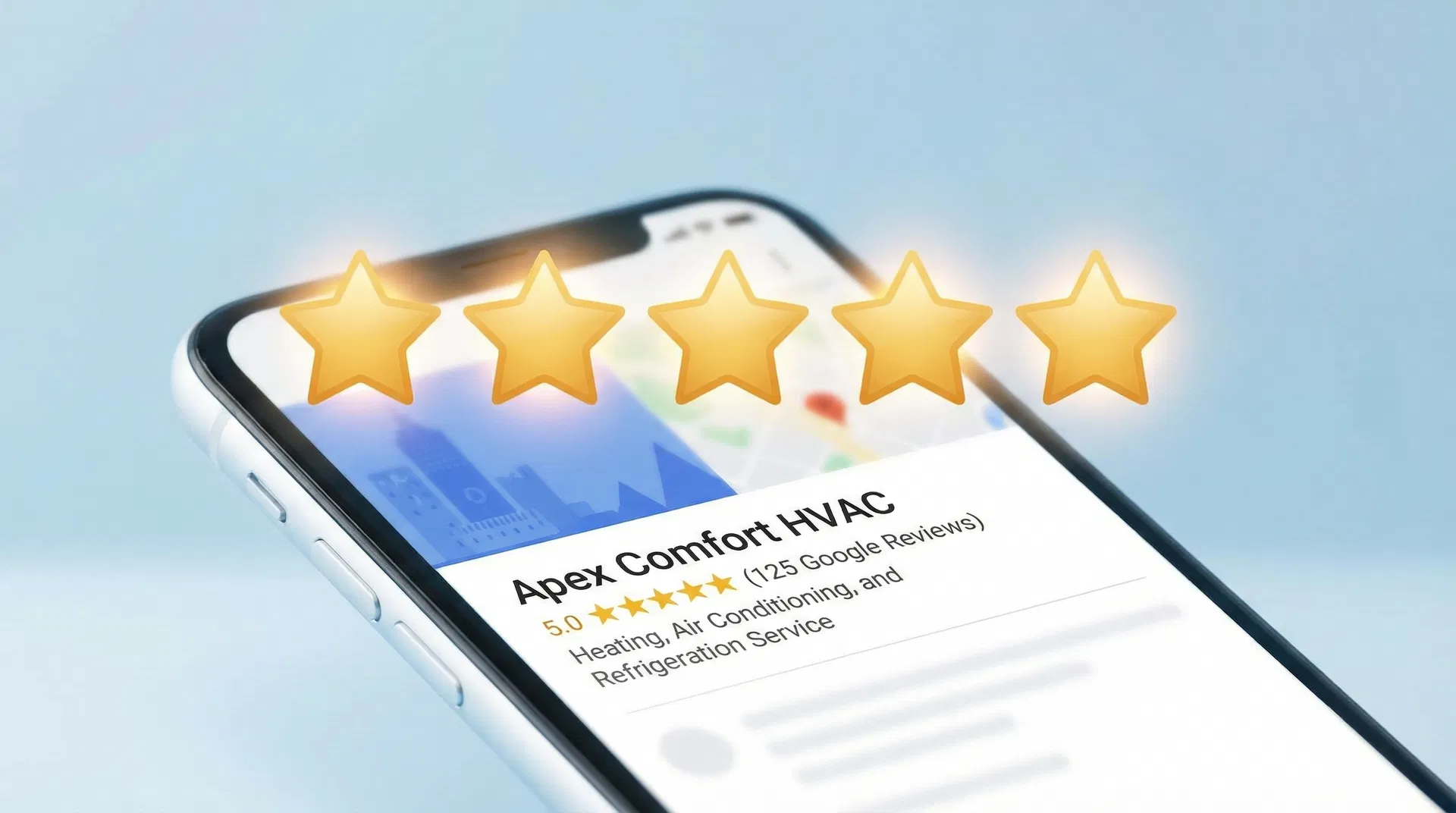
Reviews are the #1 factor in local HVAC search rankings and customer trust. Yet most HVAC companies have fewer than 20 reviews — not because their work is bad, but because they never built a system to collect them. Here's how to fix that.
Why Google Reviews Matter More Than Ever for HVAC Companies
When a homeowner in Phoenix, AZ searches 'AC repair near me,' Google displays the top three local results in what's known as the Map Pack — a prominent box above the organic search results. The companies that appear in the Map Pack get the vast majority of clicks and calls. And the single biggest factor in determining which companies appear there? Reviews. Specifically, the number of reviews and the average star rating. Beyond rankings, reviews are the primary trust signal that converts a searcher into a caller. Research by BrightLocal found that 87 percent of consumers read online reviews for local businesses, and 79 percent trust online reviews as much as personal recommendations. For HVAC companies, where customers are inviting a stranger into their home, trust is everything — and reviews are the fastest way to establish it.
How Reviews Impact Local SEO and Google Maps Visibility
Google's local ranking algorithm weighs three factors: relevance, distance, and prominence. Reviews directly affect prominence — a company with 150 reviews and a 4.8-star rating will consistently outrank a competitor with 12 reviews and a 4.2-star rating, even if the competitor has a better website. In Atlanta, GA and Dallas, TX, where HVAC competition is intense, the difference between appearing in the Map Pack and not can mean the difference between 50 inbound calls per month and 5. Companies that actively build their review count compound their advantage over time — each new review makes it harder for competitors to displace them from the top positions.
Why Most HVAC Companies Don't Get Enough Reviews
- 1They rely on customers to leave reviews voluntarily — which almost never happens without a prompt.
- 2They ask verbally at the end of a job, which is easy to forget and easy for the customer to ignore.
- 3They feel awkward asking for reviews and so they simply don't.
- 4They have no system — asking is inconsistent and depends entirely on the individual technician.
- 5They don't make it easy — no direct link, no QR code, no text with a one-tap review button.
- 6They ask too late — waiting days or weeks after a job when the customer's enthusiasm has faded.
The Automated Post-Job Review Request Sequence
The most effective review collection system sends an automated text message to the customer within 30 to 60 minutes of a job being marked as complete in your CRM. The message is short, warm, and includes a direct link to your Google review page. Example: 'Hi [Name], thanks for having us out today! If you have a moment, we'd really appreciate a Google review — it helps our small business a lot. Here's the link: [link]. Thanks, [Technician Name].' This single automation, properly set up in a platform like GoHighLevel, generates 4 to 8 new reviews per month for the average HVAC company — without any awkward asking, without any manual effort, and without any additional cost. Companies in Toronto, ON and Denver, CO that implement this system typically double their review count within 90 days.
What to Say and When to Ask
Timing is the most important variable in review collection. The optimal window is 30 to 90 minutes after job completion — when the customer is still in the warm glow of a problem solved, but before the experience fades into the background of their day. Asking the next day or the day after significantly reduces response rates. The message itself should be personal, brief, and low-pressure. Use the technician's name. Reference the specific job if possible ('Thanks for letting us service your AC today'). Make the ask feel like a favour rather than a transaction. And always include a direct link — never ask someone to 'find us on Google.' Every extra step reduces completion rates dramatically.
How to Respond to Negative Reviews Professionally
Negative reviews are inevitable. How you respond to them matters as much as the review itself — because potential customers read both. A professional, empathetic response to a negative review actually increases trust. It shows that you take customer satisfaction seriously and that you're willing to make things right. The formula is simple: acknowledge the experience, apologise without admitting fault, offer to resolve it offline, and provide a contact number. Never argue, never get defensive, and never ignore a negative review. In Houston, TX and Seattle, WA, the HVAC companies with the best reputations are often the ones that handle negative reviews the best — not the ones that never receive them.
Turning Reviews Into Marketing Assets
Once you have a strong review base, use it everywhere. Feature your star rating and review count prominently on your website homepage. Include your best reviews in your Google Ads. Share positive reviews on social media. Use customer quotes in your estimate follow-up emails. Reviews are the most credible marketing content you can produce — because you didn't write them, your customers did. Every new review is a piece of marketing content that works for you indefinitely. A company with 200 five-star reviews has a marketing asset that would cost tens of thousands of dollars to replicate through paid advertising.
Want This System Built for Your Business?
We install done-for-you revenue systems for HVAC companies. Book a free 30-minute Revenue Audit and we'll show you exactly what's leaking and how to fix it.
Book My Free Revenue AuditFrequently Asked Questions
How many Google reviews does an HVAC company need to rank?
There's no magic number, but HVAC companies with 50 or more reviews and a rating above 4.5 stars consistently appear in the Google Maps Pack in most markets. In highly competitive cities like Phoenix or Atlanta, you may need 100+ reviews to compete for top positions. The key is continuous accumulation — aim for at least 4 to 8 new reviews per month.
When is the best time to ask a customer for an HVAC review?
The optimal window is 30 to 90 minutes after job completion, while the customer is still feeling positive about the experience. Automated review requests sent via SMS within this window achieve significantly higher response rates than requests sent the next day or later. Never wait more than 24 hours.
Can I automate Google review requests for my HVAC business?
Yes — and you should. A CRM like GoHighLevel can automatically send a personalised review request text to every customer within minutes of a job being marked complete. This removes the awkwardness of asking in person and ensures every customer receives a request consistently, regardless of which technician completed the job.
How do I respond to a negative HVAC Google review?
Acknowledge the experience, apologise sincerely, and offer to resolve the issue offline. Provide a direct contact number or email. Keep the response brief, professional, and empathetic — never defensive. A well-handled negative review can actually increase trust with potential customers who see that you take feedback seriously.
Do Google reviews help HVAC local SEO rankings?
Yes — Google reviews are one of the most significant factors in local search rankings. The number of reviews, the average star rating, and the recency of reviews all contribute to your Google Maps Pack visibility. Companies that actively collect reviews consistently outrank competitors with fewer or older reviews, even when other factors are equal.